Why Does Cortana Only Read Some Wiki Pages
Dunbar'due south number: Why we can only maintain 150 relationships
(Image credit:
Emmanuel Lafont
)
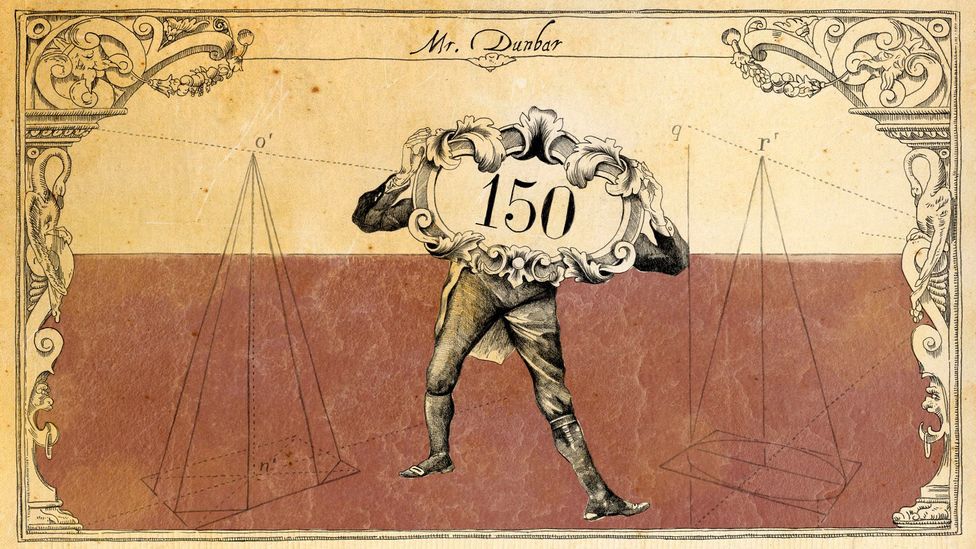
The theory of Dunbar'southward number holds that we tin can only really maintain well-nigh 150 connections at once. But is the rule true in today'south globe of social media?
I
If you've ever been romantically rejected by someone who just wanted to be friends, you lot may have delivered a version of this line: "I've got enough friends already." Your implication, of course, being that people just have plenty emotional bandwidth for a certain number of buddies.
It turns out that'due south not just an excuse. There are well-divers limits to the number of friends and acquaintances the average person can retain. But the question almost whether these limits are the aforementioned in today's digital world – one in which it'southward common to have social media profiles, or online forums, with thousands of followers – is more than complicated.
According to British anthropologist Robin Dunbar, the "magic number" is 150. Dunbar became convinced that there was a ratio between encephalon sizes and group sizes through his studies of non-man primates. This ratio was mapped out using neuroimaging and ascertainment of fourth dimension spent on grooming, an of import social behaviour of primates. Dunbar concluded that the size, relative to the torso, of the neocortex – the part of the brain associated with noesis and language – is linked to the size of a cohesive social grouping. This ratio limits how much complexity a social system can handle.
Y'all might also like:
• The numbers that can lead to disaster
• Is social media bad for you?
• The '3.five% rule': How a small minority can change the globe
Dunbar and his colleagues practical this basic principle to humans, examining historical, anthropological and contemporary psychological data near grouping sizes, including how big groups get before they separate off or collapse. They plant remarkable consistency around the number 150.
According to Dunbar and many researchers he influenced, this dominion of 150 remains true for early on hunter-gatherer societies also as a surprising array of modern groupings: offices, communes, factories, residential campsites, armed forces organisations, 11th Century English villages, even Christmas menu lists. Exceed 150, and a network is unlikely to terminal long or cohere well. (Ane implication for the era of urbanisation may exist that, to avert alienation or tensions, urban center residents should find quasi-villages within their cities.)
According to Dunbar'south theory, people can 'handle' upwards to about 150 relationships – whether in early hunter-gatherer societies or the modern workplace (Credit: Emmanuel Lafont)
Dunbar has a sense of humour about condign virtually synonymous with a number – an unusual bragging correct for a social scientist. "The odd thing about it is nigh people who have things named after them are actually expressionless," he observes drily.
Merely 150 alone doesn't tell the whole story. Other numbers are nested inside the social encephalon hypothesis as well.
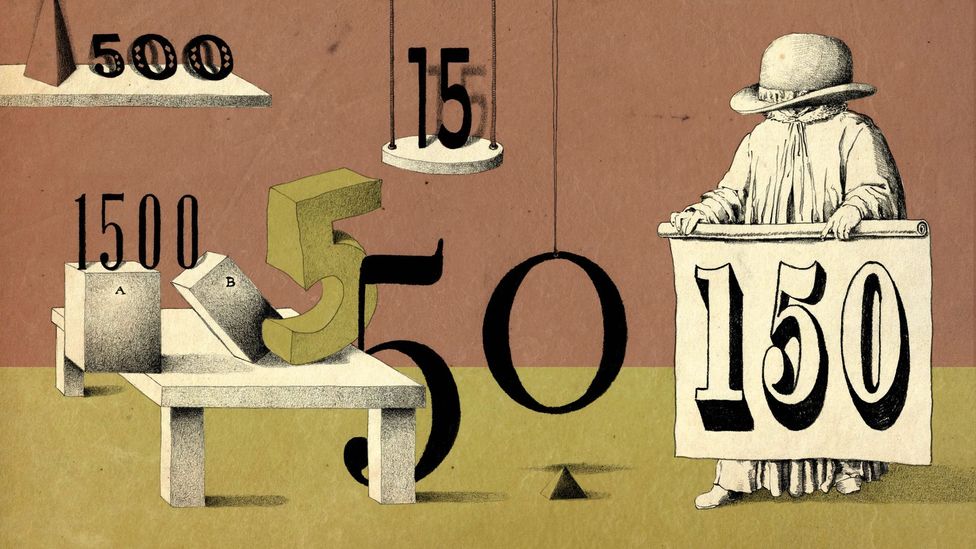
According to the theory, the tightest circumvolve has merely five people – loved ones. That'southward followed by successive layers of 15 (good friends), 50 (friends), 150 (meaningful contacts), 500 (acquaintances) and 1500 (people you tin can recognise). People migrate in and out of these layers, but the idea is that space has to exist carved out for whatever new entrants.
Dunbar isn't sure why these layers of numbers are all multiples of 5, but says, "this number five does seem to be fundamental to monkeys and apes in general".
Of course, all of these numbers really represent range. Extroverts tend to have a larger network and spread themselves more than thinly across their friends, while introverts concentrate on a smaller pool of "thick" contacts. And women generally have slightly more than contacts inside the closest layers.
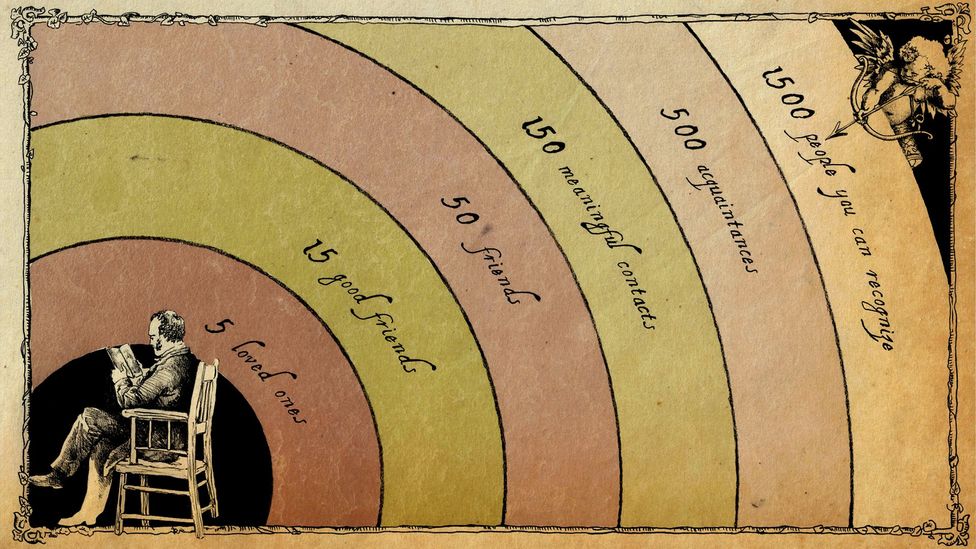
The almost intimate circumvolve is just 5 loved ones, reaching a maximum of 1500 people you tin can recognise (Credit: Emmanuel Lafont)
"What determines these layers in real life, in the face-to-face world… is the frequency at which yous encounter people," says Dunbar. "You lot're having to brand a decision every day nearly how you invest what time you have available for social interaction, and that's limited."
Certain organisations have taken these ideas to center. The Swedish Revenue enhancement Authorisation, for instance, has restructured their offices to stay inside the 150-person threshold.
Debating Dunbar
Not anybody subscribes to the social brain hypothesis. Some are sceptical nearly the possibility of deriving a magic number for social interaction at all.
Even so, it can be a useful exercise for thinking through communities and development.
"Although there are many factors that can limit the number of relationships that we create and maintain, these studies help us to meliorate sympathize… and measure such variables' influence," says Cristina Acedo Carmona, an anthropologist and economist at the University of León in Espana.
Among those who agree that a Dunbar-ian number can be constitute, some contest whether it's 150. Inquiry on varied social groups in the US suggests that their social networks cluster around 290 in size. And these numbers may exist significantly skewed by outliers.
1 statement is that the number of social connections isn't normally distributed (or shaped like a bell curve), so a few people with massive numbers of contacts may be throwing off the average.
For instance, if someone is wealthy enough to hire assistants to partly manage their relationships – or to outsource some of the emotional labour to others – they might be less constrained by the number of relationships they can comfortably maintain. As in so many aspects of social life, the super-connected are the super-privileged.
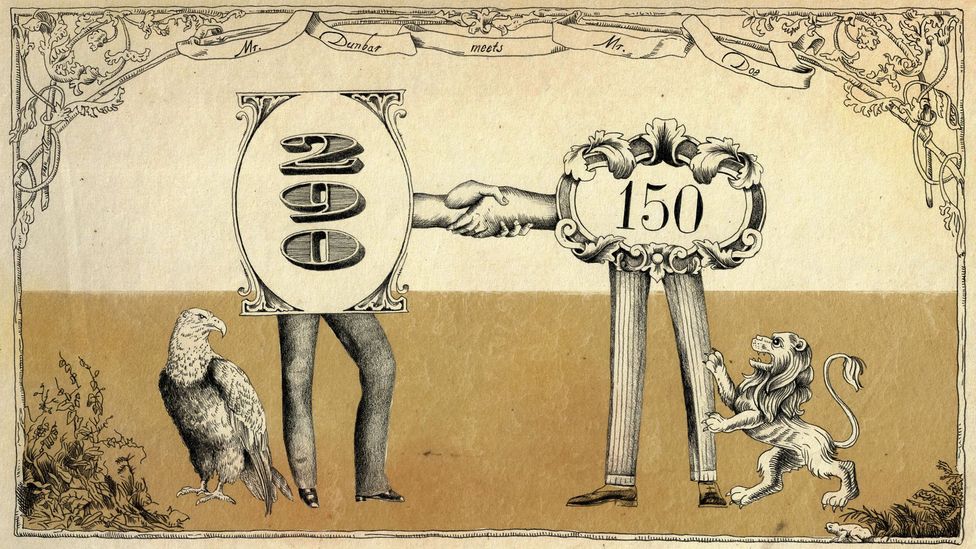
Some The states social networks cluster around 290 in size, rather than 150 (Credit: Emmanuel Lafont)
There are also critiques of Dunbar's number on methodological grounds. Primates' encephalon sizes are influenced by other aspects as well social complication: factors such as diet may explain them too. And a British-Dutch squad has argued that even though the neocortex is finite, social capacity can be stretched in dissimilar cultural settings and with the aid of unlike technologies. I case is the apply of all-encompassing mobile phone contact lists past low-income Jamaicans. These lists, which involve conscientious cultivation of even casual relationships, oft incorporate many more than 150 contacts.
Indeed, social capital tin be specially important for people who don't have other forms of capital, as suggested by Acedo Carmona's comparative inquiry on northern Ghana and Oaxaca, Mexico. Loftier biological variety, remote mountainous settings, and the influences of Spanish colonialism on ethnic identities have all contributed to Oaxaca's small trust circles, largely consisting of nuclear relatives. But northern Ghana's scarcer ecology resources have made inter-ethnic cooperation and larger trust circles more important for survival. Thus, "focusing on brain size and cerebral limitations may exist overly simplistic", Acedo Carmona stresses.
Dunbar's number may be most applicable for premodern societies or for eye-income groups in contemporary Western societies. Research that supports it is skewed towards Weird (Western, educated, industrialised, rich and democratic) societies.
Simply fifty-fifty these are becoming more complicated, due to the manner internet culture is transforming relationships.
Online presence
One modern-day version of a cave-side campfire gathering is Slack, the email replacement app that's been delighting workplace communications pros, and exhausting overworked employees, since 2013. And ane person who's taken advantage of Slack'due south community-edifice possibilities is United states digital designer Carly Ayres.
Several years ago Ayres created a Slack group for fellow designers, 100s Under 100. It now hosts 84 channels moderated by 14 admins, who are aiming to diversify the grouping backside its initial core of white US women.
Dunbar'due south number makes intuitive sense to Ayres, given her observations of online communities. "I do think in that location'south some truth to the thought that there'south only really so much information you can keep in your head… so many avatars. The more you know nearly someone, I remember the better that human relationship is, but probably also limits the number of relationships yous tin can have," she says.
Fifty-fifty online, it's easier to take stronger relationships when you lot have fewer of them (Credit: Emmanuel Lafont)
100s Under 100 aims for a balance between size and intimacy by splintering channels into smaller ones when they become unwieldy. Akin to "a state school or a large academy, you lot make it smaller with subcommunities", Ayres explains.
The grouping too purges inactive members periodically – a more than deliberate class of the way everyone lets sure relationships fade away because of insufficient time or energy to maintain them.
More and more people are preaching the gospel of small being improve when information technology comes to online social life. Scale may be one of the bug with the massive social networking sites that at present boss our lives. And for certain Facebook users, the smaller and more undercover the groups, the better.
Thus far, the enquiry of Dunbar and colleagues on online relationships suggests that these are similar to offline relationships in terms of numerical restrictions. "When people looked at the structure of online gaming globe, they get near the same layers every bit we get in all of the other contexts," he says. "And it just looks as though it's the same design features of the human being mind that are imposing constraints on the number of individuals you lot can kind of work with mentally at any one fourth dimension."
Dunbar and colleagues likewise have performed research on Facebook, using factors similar the number of groups in common and private messages sent to map the number of ties against the strength of those ties.
When people have more than 150 friends on Facebook or 150 followers on Twitter, Dunbar argues, these stand for the normal outer layers of contacts (or the low-stakes connections): the 500 and 1500. For most people, intimacy may just non be possible beyond 150 connections. "These digital media – and I'm including telephones in there – are really merely providing you with another machinery for contacting friends," Dunbar says.
In that location is a residuum between the amount of connections yous take and the intimacy of those connections (Credit: Emmanuel Lafont)
Even the possibility of anonymity online doesn't seem to Dunbar to be essentially different to the offline earth. He compares bearding internet interactions to the use of confessionals in the Catholic church. It isn't a close relationship, but it is one that recognises the benefits of confidentiality amid quasi-strangers.
"It'southward extremely difficult to cry on a virtual shoulder," Dunbar deadpans. "Having a conversation isn't like a lighthouse; it is non only blinking away out there and perchance someone is listening, and maybe somebody is not."
In this view, the not-physical, non-existent-fourth dimension nature of internet relationships means that they can't claiming "real-world" ones in meaningful ways. Face-to-face relationships, with all the non-exact information that is then disquisitional to communication, remain paramount.
Merely Dunbar's own research suggests generational differences in this regard. Those aged xviii–24 have much larger online social networks than those anile 55 and above. And the primacy of physical contact in the social brain hypothesis may apply less to young people who have never known life without the net, for whom digital relationships may be just equally meaningful as counterpart ones.
Plus, online groups like 100s Under 100 aren't intended to last forever; Ayres initially envisioned that the group would deliquesce inside a few years. Without the pressure for longevity, ideal community size may be less relevant.
Information technology makes sense that there'south a finite number of friends most individuals can have. What's less clear is whether that capacity is being expanded, or contracted, by the always-shifting ways people interact online.
Invisible numbers
Curious about the hidden forces shaping the world? So are we. This article is part of our Invisible Numbers serial, where nosotros explore the digits, percentages and equations that govern our everyday lives in dramatic means, often without us realising information technology.
Source: https://www.bbc.com/future/article/20191001-dunbars-number-why-we-can-only-maintain-150-relationships
0 Response to "Why Does Cortana Only Read Some Wiki Pages"
Post a Comment